
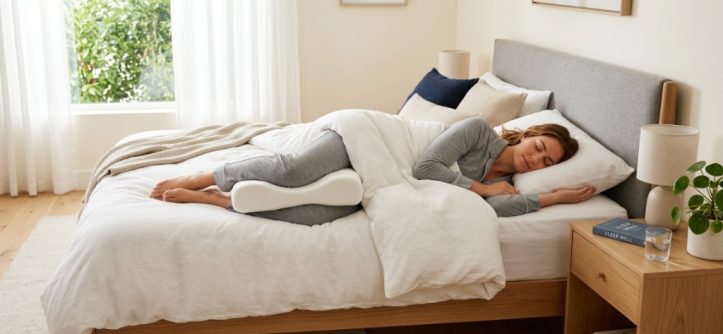
Waking up with a locked lower back, a numb leg, or a nagging ache in your hip is a frustrating way to start the day. If you’re a side sleeper, the culprit is often how your legs rest overnight, causing your spine to twist out of alignment. The simplest solution sounds obvious—place a pillow between your knees—but finding a supportive option that doesn’t break the bank can feel like a scavenger hunt. Cheap foam often flattens overnight, while premium memory foam gets pricey fast. But the sweet spot exists.
This guide breaks down exactly what you need to look for in an affordable knee pillow for side sleepers, explaining the materials, shapes, and firmness levels that actually work, without the markups you see on boutique brands. We’ll cover specific budget-friendly picks, how to test if a cheap pillow is worth your money, and when you can skip the splurge.
Why Do Side Sleepers Actually Need a Knee Pillow?
A knee pillow isn’t just a comfort accessory; it’s a tool for spinal alignment. When you sleep on your side without support between your knees, your top leg pulls down on your pelvis, causing the lower back to twist into an unnatural position. Over time, this leads to stiffness and chronic joint pain.
The Biomechanics of Side Sleeping
Your hip is roughly the width of your shoulder. When you lie on your side, gravity drags the top leg down towards the mattress. This creates a rotational torque on the lumbar spine. Placing a pillow between the knees elevates the top leg to hip height, neutralizing that pull and keeping the spine straight from the neck to the tailbone.
Immediate Benefits Beyond Back Pain
Besides protecting your back, a knee pillow prevents pressure sores and friction between the bony parts of your knees and ankles. For anyone with sciatica, a pinched nerve, or post-surgical hip pain (like after a replacement), this support is non-negotiable. It also improves circulation by reducing pressure on major veins behind the knee.
When is it Absolutely Necessary?
If you wake up with a stiff lower back, feel numbness in your top leg, or struggle with sleeping on your side due to hip bursitis, you are a prime candidate. Even if you don’t have pain yet, using a pillow here is preventive—similar to wearing a seatbelt. It’s about preserving your range of motion for decades to come.
What Materials Offer the Best Value for Low Cost?
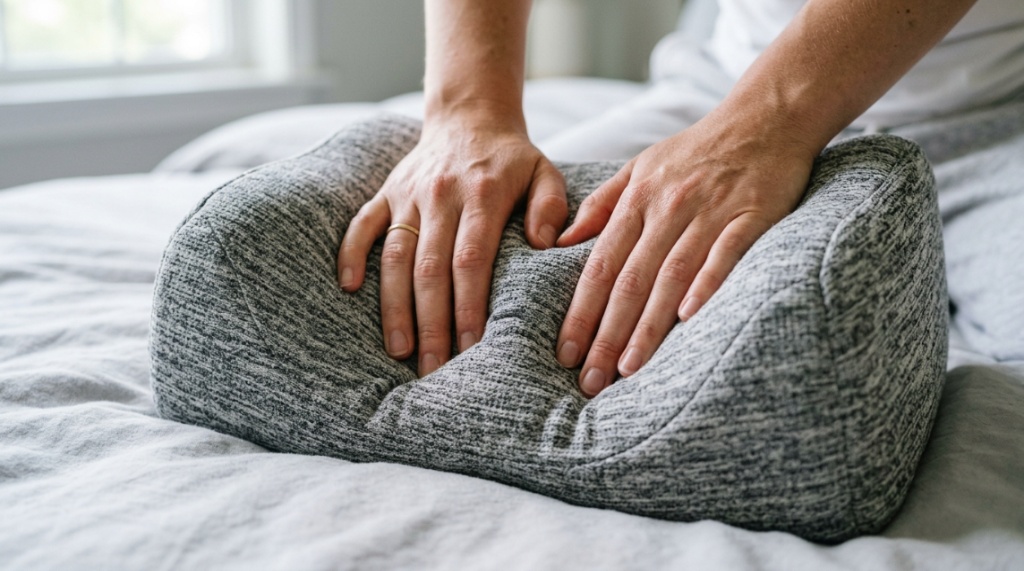
Polyester fiberfill, shredded memory foam, and solid memory foam are the three primary materials in inexpensive knee pillows. Each has distinct pros and cons that affect longevity and support.
Polyester Fiberfill: Lightweight but Short-Lived
Often found in hotel pillows and budget options, this material is fluffy and soft. It feels great initially but compresses significantly within a few hours. For a knee pillow, this means you get minimal loft by 3 AM, effectively nullifying its purpose. If you buy this, you need to choose a design with heavy gusseting (extra side walls) to maintain height.
Shredded Memory Foam: The Adaptive Budget Choice
Shredded foam offers a malleable feel that contours to the curve of your leg. It provides more resistance than fiberfill and is usually heavier. The downside? It can shift around in the cover overnight. Look for a pillow with internal baffles to hold the shreds in place. This is often the best balance of cost and function.
Solid Viscoelastic Foam: Max Support, Higher Price
Solid memory foam is the most durable and supportive but typically costs more. However, you can find value options if you skip the added “cooling gel” layers. A dense solid foam block that is 4 to 5 inches thick will do the job effectively. It’s heavier, but it won’t slide out from between your legs easily.
Which Knee Pillow Shape is Worth Your Money?
You’ll find contoured ergonomic shapes, simple rectangles, and strap-on designs. For budget buyers, the design dictates whether you get actual pain relief or just a nuisance.
Contoured and Ergonomic Pillows
These have a curved design that wraps around the thigh and lower leg. They are highly effective because they keep the pillow cradled between your legs even when you toss and turn. However, a poorly designed “ergonomic” cheap pillow can feel too tall or put pressure on specific spots. You need to check the height carefully.
Simple Rectangular Flat Pillows
The classic rectangular shape is versatile—you can place it longitudinally along your entire leg. This is great for keeping your ankles separated too. They are cheaper because they are easier to manufacture. But they tend to slip out of place unless your legs are holding them tightly.
Strap vs. No Strap: Which is Better?
Strap pillows have an adjustable band that wraps around your upper thigh to keep the pillow in place. If you move a lot in bed, this is essential. However, straps on cheap models are often made of rough elastic that irritates skin. A strap is useful, but only if it’ feels soft against the skin.
How Do You Test Firmness Without Laying Down?
You cannot judge a knee pillow by squeezing it with your hand alone. The firmness must be relative to your body weight and the width of your hips. A pillow that works for a 130-pound person will feel like a rock to a 200-pound person.
The “Squish” Test Logic
Look for a pillow that compresses down by 30% to 40% when you lay your full leg weight on it. If it only compresses 10%, it’s too hard. If it compresses 80% and hits the bone, it’s too soft. You want the foam to sink to a thickness that just fills the gap between your knee and the mattress.
Reading Reviews for Weight-Specific Feedback
When shopping online, filter reviews for people with your body type. Check for comments like “I am 5’8″ and 180 lbs and this was too tall” or “perfect for petite frames.” Ignore the five-star general ratings; look for the specifics about compression and loft.
The Edge Test
Press your thumb into the pillow. Does it spring back immediately? Or does it hold the dent? Slow-recovery foam (memory foam) is usually better for joint pressure relief. Fast-recovery foam (like high-resilience foam) is bouncier but exerts more pushing force against your skin. For knees, you want slow recovery.
Why Do Some Cheap Knee Pillows Wear Out Fast?
The most common complaint with budget pillows is losing loft. This usually happens because manufacturers use low-density foam that breaks down under repetitive compression. Here is how to identify a durable cheap option.
Understanding Foam Density vs. Firmness
Firmness is how hard it feels. Density is how much material is packed inside. A high-density but soft pillow will last long (it holds up over time). A low-density but firm pillow will feel hard initially but collapse after a month. Look for “high-density” in the specifications, not just “firm.”
Check the Cover Quality
A removable, washable cover made of bamboo rayon or cotton is crucial. Not only for hygiene, but the cover also adds friction. A slippery polypropylene cover will slide off the bed, causing your pillow to shift. The fabric’s weave matters as much as the foam inside.
Warranty and Return Policy
Budget brands that offer a 1-year warranty are usually more trustworthy than those with none. If the pillow flattens within 90 days, you should be able to return it. A good return policy is your safety net against a cheap manufacturing defect.
Can a Low-Cost Pillow Help With Sciatica and Hip Pain?
Yes, but only if the height is precise. For sciatica, a pillow that is too tall will rotate the spine and worsen nerve pain. For hip bursitis, a pillow that is too soft won’t relieve pressure on the lateral hip.
Adjusting Flare-Ups
During a severe sciatica flare-up, you might need a slightly thinner pillow. You can even fold a standard pillow in half and use it. The goal is to keep the angle of the hip at a neutral 90-degree relationship with the spine, not to mimic the natural hip width exactly.
The “Top Leg” Rule
If your top leg hurts, the pillow is likely too thick. If your bottom hip hurts, the pillow is likely too thin or your mattress is too hard. The fix isn’t always buying a new knee pillow—sometimes, you need to add a small cushion under your waist to correct the whole setup.
When to see a professional
A pillow is a supportive tool, not a medical treatment. If you have been sleeping with a pillow for three weeks and your pain is still a 5 out of 10, you need to consult a physical therapist. They can assess if your hip rotation issue is a muscular imbalance that needs stretching, not just nocturnal support.
How Much Should You Pay for a Quality Budget Pillow?
Based on current market analysis, the sweet spot for a quality knee pillow is between $15 and $30. Anything below $10 is typically a thin travel pillow. Anything above $40 is entering premium territory where you’re paying for brand names and marketing.
Price vs. Longevity Math
If you buy a $10 pillow that needs replacing every six months, you will spend $20 a year. If you buy a $25 pillow that lasts two years, you save money in the long run. Look for durability, not the lowest upfront cost.
Sales and Coupon Codes
Amazon and big-box retailers frequently run lightning deals on bedding. You can often find a mediflow or similar reputable brand for under $20 if you check price tracker websites. Don’t pay full price for a pillow that is on sale three times a month.
What Does “Affordable” Really Mean?
In this context, affordable means the cost per use. A $25 pillow used every night for 500 nights is 5 cents a night. That is remarkable value for improved sleep quality. You don’t need the $80 version with a cooling gel top if you already have a cool bedroom.
Which Budget-Friendly Brands and Picks Stand Out?
While we don’t endorse specific manufacturers without research, certain types of products consistently outperform others on budget forums. A specific guide can help you pinpoint the exact model that fits your body. For a curated list of top-rated inexpensive options that have been tested for durability and compression, check this resource on the affordable knee pillow for side sleepers. It offers a comparative analysis that saves you hours of scrolling.
Evaluating the “Cnta” and Generic Brands
Generic brands like “ComfiLife” or “Sleep Innovations” often provide the best value. They use standard memory foam densities and simple contoured shapes that work well. Just read the “thickness” spec carefully—many are 5 inches, which is too tall for petite individuals.
Hotel Quality vs. Home Use
Many hotels use cheap, dense foam blocks that are not sold to the public. You can find similar “medical grade” options from medical supply stores that are cheaper than big sleep brands. Look for “physical therapy” grade pillows, as they are designed for patient recovery, not luxury, thus costing less.
DIY Alternatives as a Stopgap
If you need a solution tonight, a rolled-up firm bath towel tucked under your knees works surprisingly well for alignment. It is free and adjustable. But for long-term sleep use, this will compress and can cut off circulation if rolled too tight. It’s a stopgap, not a solution.
How to Break In and Extend the Life of a New Knee Pillow
New budget foam can feel stiff right out of the box. Do not rage-return it immediately—most foam needs a break-in period.
The 48-Hour Rule
Unbox the pillow and let it air out for 48 hours. Many budget foams are vacuum-sealed and need time to expand. If it doesn’t expand to its full size within two days, then it’s a defective product. If it does, test it for two nights before making a judgment.
Seasonal Storage
If you change pillows seasonally, store this one flat in a cool, dry place. Do not hang it or bend it, as this will crack the foam structure. A flat storage container under the bed is the best way to preserve its shape.
Cleaning Mistakes to Avoid
Never put memory foam in the washing machine. Hand wash the cover only and spot-clean the foam with a damp cloth. Using harsh detergents breaks down the foam’s molecular structure, causing it to harden or crumble. Air dry completely to prevent mold.
Is a Knee Pillow Enough if You Have a Bad Mattress?
No. A knee pillow is an adjunct, not a substitute for a proper sleep surface. If your mattress sags in the middle, your hips are already dipping downward, and no knee pillow can fix that misalignment. As you look for ways to improve your sleeping posture, make sure to also check out our guide to finding budget-friendly bed pillows that feel like luxury.
Signs Your Mattress is the Real Problem
If you feel the metal springs or wake up with your lower back arching excessively despite the pillow, the mattress is too old. Typically, a mattress needs replacing every 7-10 years. If you notice a visible body impression when you sit up, it’s time.
Combining Pillows for Total Alignment
You may need to pair your knee pillow with a small lumbar roll placed behind your waist. This creates a comprehensive sleep solution. The knee pillow manages the leg rotation; the lumbar roll manages the spine curve. Together, they mimic a proper sleeping posture.
When Upgrading Makes More Sense
If you are sleeping on a $100 air mattress or a 15-year-old spring coil bed, your $20 knee pillow is a band-aid. Save up for a firmer mattress foundation or a medium-firm hybrid mattress. That investment will yield better returns than buying ten different pillows.
Frequently Asked Questions
Can a knee pillow make my leg numb?
Yes, if the pillow is too thick or placed directly behind the knee joint where the nerves are superficial. Place the pillow higher up, between the thighs, to avoid compressing the popliteal nerve.
How high should a knee pillow be?
It should be roughly the height of your top hip bone from the mattress surface. For most adults, this is between 4 and 6 inches when compressed. If it’s too high, it increases strain on the lower back.
Is it better to use a body pillow instead?
A body pillow is a great alternative for side sleepers because it also supports the top arm and shoulder. If you have neck pain, a full-length body pillow may be a better investment than a small knee-only pillow.
Are gel-infused knee pillows worth the extra cost?
Not if you sleep in a cool environment. The gel is designed to pull heat away from the skin. If you sleep hot, it helps slightly, but standard memory foam is often sufficient. Save your money if you are on a strict budget.
Can children use knee pillows for side sleeping?
Children can use them, but they need much thinner support—typically 2 to 3 inches. Using an adult-sized pillow can misalign their developing hips. A rolled baby blanket is safer for kids under 10.
How often should I replace a budget knee pillow?
If you wash the cover regularly, you should replace the foam core every 1 to 2 years. Once it loses its ability to snap back to its original shape after compressing, it’s time for a new one.
Conclusion
Choosing an affordable knee pillow for side sleeping doesn’t mean sacrificing your spine’s health. The right balance of foam density, height adjustability, and a breathable cover can be found for under $30 if you prioritize material science over marketing fluff. Remember to measure your hip width, check reviews for your specific weight class, and always look for a company that stands behind a return policy.
Your sleep is a daily investment. Even a simple 5-inch piece of foam can transform your mornings by eliminating the dull ache in your lower back. Start with a specific budget in mind, test the bed surface, and don’t hesitate to return the first pick if it doesn’t work for your body.
Take the guesswork out of the search—review the curated list of top-rated budget options today and pick the one that matches your sleep position.