You finally have a small kitchen, a tiny apartment, or an RV, and washing dishes by hand is eating into your evening. You know a countertop dishwasher is the solution, but the market is crowded with options that promise the world and deliver lukewarm results. The real problem isn’t finding a dishwasher—it’s finding the best countertop dishwasher California residents trust for hard water, limited space, and energy efficiency. Without the right guidance, you risk buying a unit that doesn’t fit your counter, struggles with baked-on food, or wastes water in a drought-conscious state. This guide cuts through the noise, giving you a practical, step-by-step framework to choose a machine that actually works for your lifestyle and your California kitchen.
What Exactly Is a Countertop Dishwasher and Why Should You Consider One?
The Simple Definition
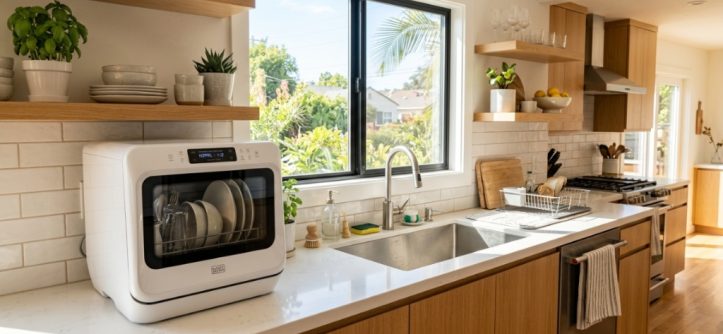
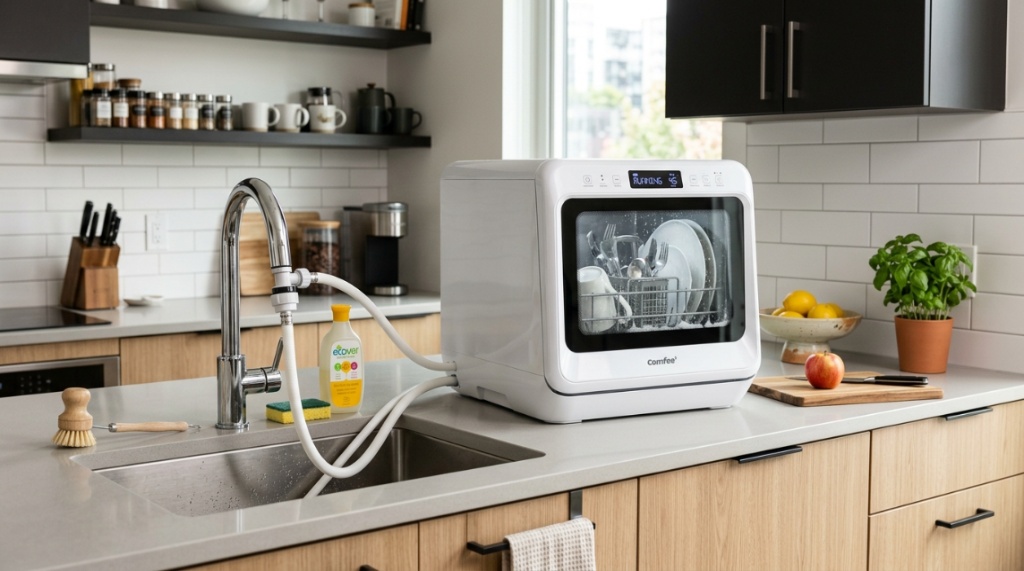
A countertop dishwasher is a compact, portable appliance that sits on your kitchen counter. It connects directly to your faucet via an adapter, washes a small load (typically 2–6 place settings), and drains into your sink. Unlike a full-size unit, it requires zero permanent installation.
Why It’s a Smart Fit for California Living
California apartments, condos, and ADUs often lack space for a built-in dishwasher. A countertop model gives you the convenience of a machine wash without losing cabinet space. Many units now meet California’s strict energy and water efficiency standards, helping you save on utility bills and conserve resources.
Who Benefits Most?
- Renters who can’t modify their kitchen
- Small families or couples
- RV and tiny home owners
- Anyone with limited counter space who still wants clean dishes on demand
How Do You Measure the Right Size for Your Counter?
Three Critical Dimensions You Must Check
Before you buy, measure the width, depth, and height of your available counter space. Most countertop dishwashers are about 17–22 inches wide, 20–22 inches deep, and 17–19 inches tall. A common mistake is forgetting to account for clearance above the unit for loading and unloading.
Capacity Confusion: Place Settings vs. Real Life
Manufacturers advertise “6 place settings,” but that usually means small plates, cups, and flatware. For real-world use, calculate how many dinner plates, bowls, and glasses you wash daily. A family of two often needs a 4–6 place setting model, while a single person can manage with a 2–3 setting unit.
Faucet Compatibility Check
Most countertop dishwashers come with a faucet adapter that works with standard threaded faucets. If you have a pull-down sprayer or a non-standard faucet, you may need an extra adapter. Measure your faucet aerator diameter (usually 55/64-inch or 15/16-inch) before purchasing.
Which Features Actually Matter for Performance and Convenience?
Wash Cycles and Customization
Look for at least three cycles: heavy, normal, and quick. A heavy cycle is essential for baked-on cheese or dried pasta sauce. A quick cycle (30 minutes or less) is perfect for lightly soiled dishes. Some premium models add a sanitize cycle that uses high-temperature water to kill bacteria, which is valuable for homes with young children or immunocompromised individuals.
Drying Method: Heat vs. Air
Heat drying uses an internal heating element to evaporate water, but it can warp plastic items. Air drying (or condensation drying) is gentler on plastics and consumes less energy. Many users prefer a model that offers both options, giving them flexibility depending on the load.
Noise Level
Countertop dishwashers are inherently noisier than built-in models because they sit on the counter. Look for a noise rating below 50 decibels. Anything above 55 dB can be disruptive in an open-concept kitchen or studio apartment.
How Does Water and Energy Efficiency Impact Your Choice?
Why California Specifics Matter
California has some of the strictest energy and water efficiency standards in the country. A best countertop dishwasher California residents should buy must carry an Energy Star certification. This ensures the unit uses less than 3.5 gallons per cycle and meets low-energy consumption thresholds.
Hard Water Considerations
Many parts of California have hard water, which leaves white spots on glassware and can shorten the dishwasher’s lifespan. Look for models with built-in water softeners or at least a rinse aid dispenser. If you can’t find one with a softener, plan to use a dedicated rinse aid and descale the unit every three months.
Long-Term Cost Savings
An efficient countertop dishwasher can save you up to 5,000 gallons of water per year compared to hand washing. While the upfront cost ($250–$600) is higher than hand washing, the savings on water and energy bills often pay for the unit within 12–18 months.
What Are the Most Common Installation Mistakes?
Failing to Check the Faucet Flow Rate
Your faucet must supply at least 0.5 gallons per minute for the dishwasher to fill properly. Low-flow faucets common in California may struggle. Test your flow rate by running the faucet for 10 seconds and measuring the water volume. If it’s below 0.5 GPM, you may need a booster pump model.
Overlooking Drainage Requirements
The drainage hose must be secured so water flows freely into the sink. If the hose kinks or gets trapped under the sink basket, water can back up and cause leaks. Use the included suction cup to hold the hose in place and test the drain cycle before loading dishes.
Ignoring Weight Limits
Countertop dishwashers weigh 40–75 pounds. Ensure your countertop is solid (not a thin laminate or particleboard). If you have a weak counter, place a sturdy cutting board or plywood sheet underneath to distribute the weight.
How Do You Compare the Top Brands Without Getting Overwhelmed?
| Brand | Best For | Avg. Price | Key Feature |
|---|---|---|---|
| Danby | Budget-conscious buyers | $250–$350 | Compact design, easy installation |
| SPT (Sunpentown) | Small spaces | $300–$400 | 6 place settings, quiet operation |
| EdgeStar | Medium households | $400–$550 | Stainless steel interior, sanitize cycle |
| COMFEE’ | Feature seekers | $350–$500 | Multiple cycles, delay start, LED display |
Note: Prices are approximate and may vary by retailer. Always check current pricing and availability.
Can a Countertop Dishwasher Clean as Well as a Full-Size Model?
Real-World Washing Performance
Yes, when used correctly. Modern countertop dishwashers use powerful spray arms and high-temperature water (up to 150°F) that rival full-size units. They clean stuck-on food, grease, and grime effectively. The key difference is capacity: you can’t fit large pots, baking sheets, or tall pitchers.
Pre-Rinsing: Necessary or Not?
Scrape off large food particles, but avoid pre-rinsing. Most countertop dishwashers have sensors that detect soil levels. If you pre-rinse, the sensor may run a shorter cycle, leaving food residues behind. Trust the machine’s sensors for optimal cleaning, Before running your compact appliance, it helps to know how long a dishwasher takes to complete a standard wash cycle.
What Won’t It Handle?
- Large cast-iron skillets
- Extra-tall wine glasses
- Dishware with hand-painted designs (high heat can fade them)
- Thin plastic containers that may warp
What Maintenance Does a Countertop Dishwasher Require?
Weekly Maintenance
Remove and rinse the filter under running water to prevent clogs. Wipe down the door gasket to remove food debris. Check the spray arm holes for blockages and clear them with a toothpick if needed.
Monthly Maintenance
Run an empty cycle with a cup of white vinegar placed on the top rack. This removes mineral deposits and neutralizes odors. For hard water areas, use a descaling solution every two months to prevent limescale buildup.
Long-Term Care
Inspect the faucet adapter and hoses for cracks or leaks every six months. Replace hoses if they show signs of wear. Store the unit properly if you move: empty all water, dry the interior, and secure the hoses with twist ties.
When Is the Best Time to Buy a Countertop Dishwasher?
Seasonal Sales and Discounts
Major sales events like Memorial Day, Labor Day, Black Friday, and Amazon Prime Day offer the best discounts. Prices can drop 20–30% during these periods. If you need a unit immediately, look for open-box or refurbished models from reputable sellers.
New Model Releases
Manufacturers release new models in late spring. When a new model hits the market, previous year’s versions often go on clearance. Check consumer reviews for the older model to ensure it still meets your needs.
Emergency Buys
Your old unit dies unexpectedly. In this case, focus on availability rather than price. Many big-box retailers offer same-day pickup or next-day delivery for popular models like the Danby DDW1804WDB or the SPT SD-2213W.
How Do You Avoid Counterfeit or Low-Quality Units?
Buy from Authorized Retailers
Purchase directly from major retailers (Amazon, Home Depot, Lowe’s, Best Buy) or manufacturer websites. Avoid third-party sellers on marketplaces if the price seems too good to be true. Counterfeit units often have substandard electrical components and can be fire hazards.
Check for UL Certification
Look for the UL (Underwriters Laboratories) mark on the unit or in the product specifications. This certification ensures the appliance meets safety standards for electrical and fire hazards.
Read Real User Reviews
Focus on verified purchase reviews. Look for consistent complaints about noise, leaks, or poor cleaning. A pattern of negative reviews about a specific issue (like the door not sealing) is a red flag. Neutral reviews are often the most honest and helpful.
Frequently Asked Questions
Can a countertop dishwasher connect to any faucet?
Most connect to standard threaded faucets. If you have a pull-down sprayer, a touchless faucet, or a non-standard thread, you will likely need an additional adapter kit, often available from the manufacturer or hardware stores.
How long does a typical wash cycle take?
A normal cycle runs 90 to 140 minutes. Heavy cycles can take up to 170 minutes. Quick cycles range from 30 to 60 minutes. Shorter cycles use more water and energy, so use them sparingly for the best efficiency.
Do countertop dishwashers use a lot of electricity?
No. They typically use 0.5 to 1.2 kWh per cycle, costing about 6 to 15 cents per wash depending on your local electricity rates. They are among the most energy-efficient dishwashers available.
Can I put plastic containers in a countertop dishwasher?
Yes, but only on the top rack and only if they are marked “dishwasher safe.” Use a cooler drying cycle (air dry) to prevent plastic containers from warping or melting.
What happens if the power goes out during a cycle?
Most units pause where they are and resume when power returns. If you open the door during a power outage, the unit may drain and stop the cycle. Always close the door and wait for power to resume.
How do I descale my countertop dishwasher?
Use a commercial dishwasher descaler or a solution of equal parts white vinegar and water. Place the solution in a cup on the top rack and run a complete hot cycle. Repeat every two to three months if you have hard water.
Is a countertop dishwasher worth it for a single person?
Absolutely. It saves time, water, and energy compared to handwashing. A single person can run a load every two to three days, reducing daily dishwashing drudgery and freeing up evening time.
Conclusion
Finding the best countertop dishwasher California residents can rely on is not about chasing the cheapest price or the flashiest features. It’s about matching the right unit to your counter space, faucet compatibility, hard water reality, and daily dish load. Prioritize Energy Star certification for water and energy savings, measure your space meticulously, and choose a model with at least three wash cycles for flexibility. Remember that longevity depends on regular maintenance, especially descaling if you live in a hard water area. Now you have the framework to shop with confidence. Check your counter dimensions, compare the top brands, and read verified reviews. Your clean dishes and reclaimed evening hours are just one smart purchase away.